Blog's Page
 Blog's Page
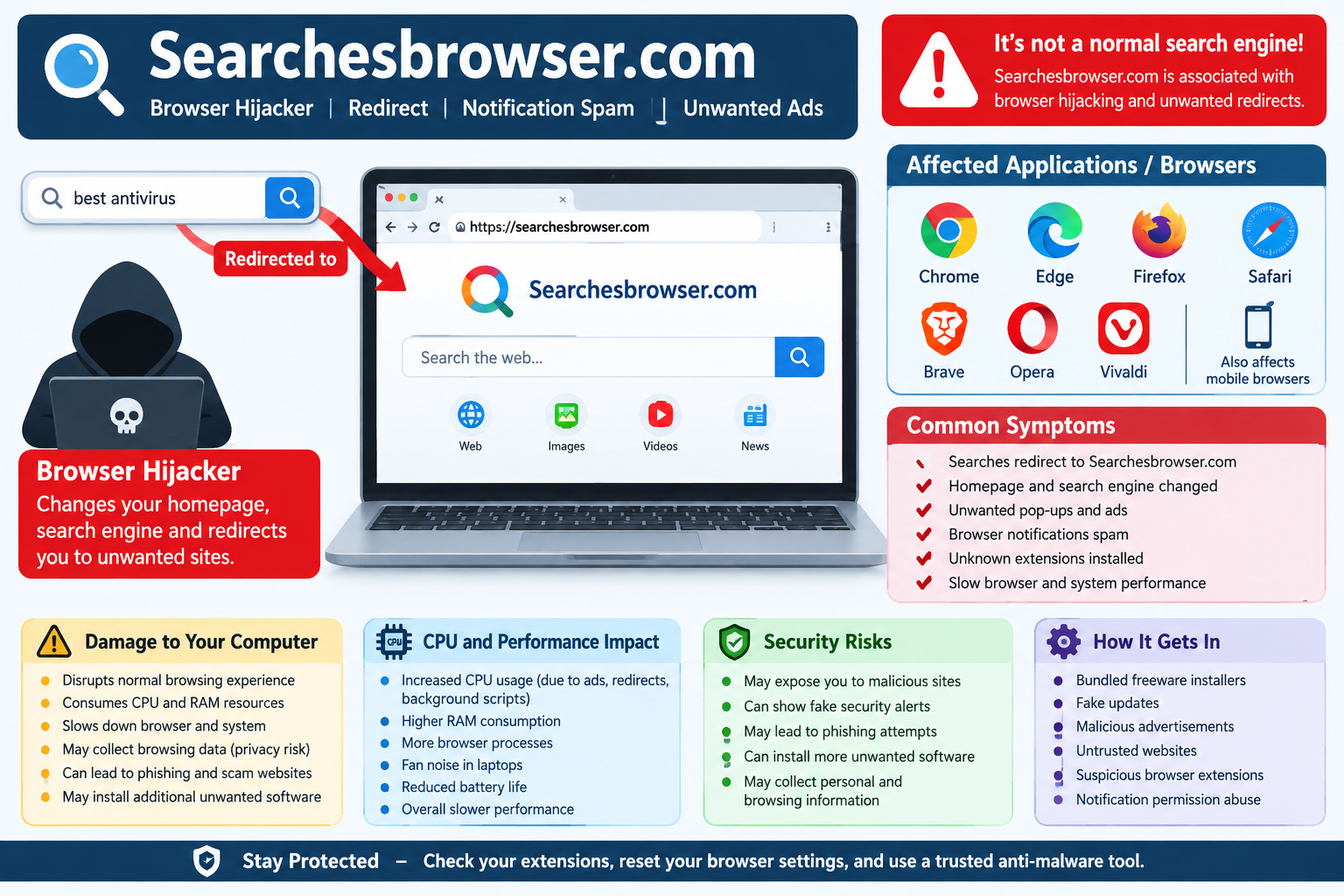
Searchesbrowser.com Is Associated With Unwanted Browser Redirection, Browser Notification Spam, And Behavior Commonly Described By Security-analysis Sites As A browser Hijacker Or Potentially Unwanted Program (PUP). Recent Reports Indicate That It Can Interfere With Browser Search Behavior, Redirect Users To The Domain, Alter Browser Settings, And Generate Unwanted Notifications Or Advertisements.
Searchesbrowser.com Should Not Be Confused With A Normal Search Engine Simply Because It Appears In A Browser Window. Security Reports Associate The Domain With Unwanted Redirects And Notification Abuse. In Some Cases, Users Reach The Site After Being Redirected From Another Website; In Other Cases, Unwanted Software Or Browser Components May Repeatedly Direct Browser Traffic Toward It.
A Typical Browser-hijacker Infection Focuses Primarily On Controlling Or Modifying The User's Web-browsing Experience. It May Change The Homepage, Default Search Engine, New-tab Behavior, Or Search Redirection Settings Without The User's Intended Configuration.
Reports Concerning Searchesbrowser.com Describe Activity Involving Major Web Browsers, Including:
Google Chrome
Microsoft Edge
Mozilla Firefox
Safari
Brave
Opera
Vivaldi
Security Reports Also Describe Notification-related Activity On Mobile Browsers, Meaning The Problem Is Not Necessarily Restricted To Windows Desktop Computers.
The Actual Affected Application Depends On How The Unwanted Component Reached The Device. A Suspicious Extension, PUP, Notification Permission, Or Another Ad-supported Component May Be Responsible.
One Of The Most Noticeable Symptoms Is unexpected Search Redirection. A User May Enter A Search Query Into The Address Bar Expecting Their Selected Search Provider, But The Browser May Instead Pass The Request Through Searchesbrowser.com. This Behavior Can Occur Because Unwanted Software Has Modified Browser Configuration Or Installed An Unwanted Extension.
Users May Also Observe An Unfamiliar Homepage, Changed New-tab Page, Unwanted Search Provider, Additional Advertisements, Or Repeated Redirects.
Another Important Behavior Associated With Searchesbrowser.com Is browser Notification Spam. Security-analysis Reports Indicate That Users Can Be Persuaded To Click An Allow Button On A Notification Request. Once Notification Permission Has Been Granted, The Browser Can Subsequently Display Unwanted Push Notifications.
These Notifications May Imitate Security Warnings, Software Updates, Prize Announcements, Advertisements, Or Other Urgent Messages. Clicking Such Notifications Can Expose Users To Additional Questionable Websites, Phishing Pages, Or Potentially Unwanted Downloads.
A Browser Hijacker Does not Necessarily Cause Consistently High CPU Usage By Itself. However, The Unwanted Components Associated With Browser Redirection Can Indirectly Affect CPU And System Performance.
For Example, Excessive Advertisements, Repeated Browser Tabs, Notification Processes, Unwanted Extensions, Background Scripts, Or Repeated Redirects Can Cause The Browser To Perform Additional Work. This May Result In:
Increased CPU Utilization
Higher RAM Consumption
Browser Freezing
Slow Page Loading
Delayed Keyboard Or Mouse Response
Increased Fan Activity On Laptops
Reduced Battery Life
Slower Overall Computer Performance
Therefore, Unusually High CPU Usage Should Not Automatically Be Attributed To Searchesbrowser.com. A Task Manager Or Activity Monitor Investigation Is Necessary To Identify The Actual Process Consuming CPU Resources.
Browser Hijackers And Associated PUPs Can Consume Additional Memory When Unwanted Extensions, Tabs, Advertisements, Scripts, And Background Browser Processes Remain Active. A Computer With Limited RAM May Therefore Become Noticeably Slower.
Temporary Files, Browser Caches, Downloaded Components, And Additional Unwanted Software Can Also Increase Disk Usage. However, Searchesbrowser.com Itself Should Not Automatically Be Considered Responsible For Every Increase In Disk Consumption.
Browser-hijacking Activity Can Create Privacy Concerns Because Unwanted Software May Interfere With Normal Browsing And Potentially Collect Browsing-related Information. The Exact Information Collected Depends On The Particular Extension Or PUP Involved.
Potentially Sensitive Information Can Include Visited Websites, Search Queries, Browser Configuration, Advertising Identifiers, And Technical Information. Users Should Therefore Investigate Unfamiliar Extensions And Applications Rather Than Simply Changing The Homepage Back.
The Most Important Danger Is Often where The Redirects Lead. Security Reports Associate Searchesbrowser.com-related Activity With Potentially Deceptive Pages, Notification Spam, Scam Content, Phishing Attempts, And Unwanted Software Distribution.
A Browser Redirect Therefore Represents A Security Concern Even When The Hijacker Itself Is Not A Destructive File-encrypting Virus. A Malicious Advertisement Or Deceptive Notification Could Persuade A User To Download Additional Software Or Disclose Credentials.
Browser Hijackers And PUPs Can Be Distributed Through Several Common Methods:
Bundled Freeware Installers
Fake Browser Or Software Updates
Malicious Advertisements
Untrusted Download Websites
Suspicious Browser Extensions
Deceptive Notification Prompts
Redirects From Compromised Or Questionable Websites
Reports Concerning Searchesbrowser.com Specifically Mention Notification-permission Abuse And Redirects As Possible Mechanisms.
A Computer Affected By Related Browser-hijacking Activity May Exhibit Several Symptoms:
Searches Unexpectedly Redirect To Searchesbrowser.com.
Homepage Settings Change Without Authorization.
The Default Search Engine Changes.
New Tabs Open Unwanted Websites.
Frequent Pop-ups Appear.
Browser Notifications Appear Unexpectedly.
Unknown Browser Extensions Are Installed.
Browser Performance Becomes Slower.
CPU Or RAM Usage Increases While Browsing.
Suspicious Advertisements Appear On Otherwise Normal Websites.
Searchesbrowser.com-related Browser Hijacking Is Primarily Associated With browser And Browsing-environment Disruption, Rather Than Direct Destruction Of Hardware. It Does Not Physically Damage A CPU, Motherboard, RAM, SSD, Or Hard Drive.
Nevertheless, Persistent Unwanted Processes Can Reduce System Performance, Consume CPU And Memory Resources, Interfere With Browser Settings, And Expose Users To Additional Security Threats. If Another Malware Component Is Present, The Overall Damage Can Be Substantially Greater.
Users Should First Inspect Installed Browser Extensions And Remove Extensions They Do Not Recognize. They Should Also Restore The Preferred Homepage And Search Engine And Revoke Notification Permission For Searchesbrowser.com.
Clearing Browser Data Can Help Remove Stored Site Information, Although It May Not Remove The Underlying Unwanted Application. A Reputable, Up-to-date Anti-malware Scanner Should Be Used To Check Windows Or Another Affected Operating System For PUPs, Adware, Or Malware. Security Guidance For Searchesbrowser.com Also Recommends Examining Browser Configuration And Scanning The Computer For Associated Unwanted Components.
Searchesbrowser.com Is Currently Associated With browser-hijacking, Redirect, And Notification-spam Activity In Multiple Security Reports. Its Primary Effects Are Unwanted Search Redirection, Browser-setting Changes, Advertisements, And Push Notifications.
While The Domain Itself Should Not Be Described As Physically Damaging Computer Hardware, Related Unwanted Software Can Contribute To Increased Browser CPU/RAM Usage, Reduced Performance, Privacy Concerns, And Exposure To Potentially Dangerous Websites. Users Experiencing Repeated Redirects Should Investigate Browser Extensions, Notification Permissions, Recently Installed Applications, And The System For Potentially Unwanted Or Malicious Software.
Step 1: Boot Into Safe Mode
Restart Your PC And Press F8 (or Shift + F8 For Some Systems) Before Windows Loads.
Choose Safe Mode With Networking.
Safe Mode Prevents Most Malware From Loading.
Press Win + R, Type appwiz.cpl, And Press Enter.
Sort By Install Date And Uninstall Unknown Or Recently Added Programs.
Use A Trusted Anti-malware Tool:
Malwarebytes – https://www.malwarebytes.com
Screenshot Of Malwarebytes - Visit Links
Microsoft Defender – Built Into Windows 10/11
HitmanPro, ESET Online Scanner, Or Kaspersky Virus Removal Tool
ZoneAlarm Pro Antivirus + Firewall NextGen
VIPRE Antivirus - US And Others Countries, | India
Run A Full Scan And Delete/quarantine Detected Threats.
Win + R, Type temp → Delete All Files.Press Win + R, Type %temp% → Delete All Files.
Use Disk Cleanup: cleanmgr In The Run Dialog.
Go To: C:\Windows\System32\drivers\etc
Open hosts File With Notepad.
Replace With Default Content:
Press Ctrl + Shift + Esc → Open Task Manager
Go To Startup Tab
Disable Any Suspicious Entries.
Open Command Prompt As Administrator.
Run These Commands:
netsh Winsock Reset

netsh Int Ip Reset

ipconfig /flushdns
Unwanted Homepage Or Search Engine
Pop-ups Or Redirects
Unknown Extensions Installed
For Chrome:
Go To: chrome://extensions/
Remove Anything Unfamiliar
For Firefox:
Go To: about:addons → Extensions
Remove Suspicious Add-ons
For Edge:
Go To: edge://extensions/
Uninstall Unknown Add-ons
Chrome:
Go To chrome://settings/reset → "Restore Settings To Their Original Defaults"
Firefox:
Go To about:support → "Refresh Firefox"
Edge:
Go To edge://settings/resetProfileSettings → "Reset Settings"
All Browsers:
Use Ctrl + Shift + Del → Select All Time
Clear Cookies, Cached Files, And Site Data
Make Sure They Are Not Hijacked.
Chrome: chrome://settings/search
Firefox: about:preferences#search
Edge: edge://settings/search
Chrome: chrome://settings/cleanup
Use Malwarebytes Browser Guard For Real-time Browser Protection.
Always Download Software From Trusted Sources.
Keep Windows, Browsers, And Antivirus Updated.
Avoid Clicking Suspicious Links Or Ads.
Use ad Blockers And reputable Antivirus Software.
Backup Your Files Regularly.
To Remove Malware From Your Windows PC, Start By Booting Into Safe Mode, Uninstalling Suspicious Programs, And Scanning With Trusted Anti-malware Tools Like Malwarebytes. Clear Temporary Files, Reset Your Network Settings, And Check Startup Apps For Anything Unusual.
For web Browsers, Remove Unwanted Extensions, Reset Browser Settings, Clear Cache And Cookies, And Ensure Your Homepage And Search Engine Haven’t Been Hijacked. Use Cleanup Tools Like Chrome Cleanup Or Browser Guard For Added Protection.
?? Prevention Tips: Keep Software Updated, Avoid Suspicious Downloads, And Use Antivirus Protection Plus Browser Ad Blockers. Regular Backups Are Essential.
Why It Matters: Not All VPNs Offer Malware Protection.
What To Look For: Providers With built-in Malware/ad/tracker Blockers (e.g., NordVPN’s Threat Protection, ProtonVPN’s NetShield).
Purpose: Prevents Data Leaks If Your VPN Connection Drops.
Benefit: Ensures Your Real IP And Browsing Activity Aren’t Exposed To Malware-distributing Websites.
Why It Matters: DNS Leaks Can Expose Your Online Activity To Attackers.
Solution: Enable DNS Leak Protection In Your VPN Settings Or Use A Secure DNS Like Cloudflare (1.1.1.1).
Risk: Free VPNs Often Contain Malware, Sell User Data, Or Lack Security Features.
Better Option: Use Reputable Paid VPNs That Offer security Audits And Transparent Privacy Policies.
Some VPNs Block Known Phishing And Malicious Sites.
Example: Surfshark’s CleanWeb, CyberGhost’s Content Blocker.
Reason: Security Patches Fix Known Vulnerabilities.
Tip: Enable Auto-updates Or Check For Updates Weekly.
Scope: Malware Can Enter Through Phones, Tablets, Or IoT Devices.
Solution: Install VPN Apps On Every Internet-connected Device.
Fact: VPNs Do Not Remove Or Detect Malware On Your System.
Complement It With:
Antivirus Software
Firewall
Browser Extensions For Script Blocking
VPN Encrypts Traffic But Can’t Stop Malware From Executing If You Download Infected Files.
Split Tunneling Allows Certain Apps/sites To Bypass VPN.
Tip: Never Exclude Browsers, Email Clients, Or Download Managers From VPN Tunneling.
A VPN (Virtual Private Network) Enhances Your Online Privacy By Encrypting Your Internet Traffic And Masking Your IP Address. It Protects Your Data On Public Wi-Fi, Hides Browsing Activity From Hackers And ISPs, And Helps Bypass Geo-restrictions. VPNs Also Add A Layer Of Defense Against Malware By Blocking Malicious Websites And Trackers When Using Advanced Features. However, A VPN Does Not Remove Existing Malware Or Act As Antivirus Software. For Full Protection, Combine VPN Use With Antivirus Tools, Regular Software Updates, And Cautious Browsing Habits. Always Choose A Reputable VPN Provider With Strong Security And Privacy Policies.
Searchesbrowser.com, Remove Searchesbrowser.com, Delete Searchesbrowser.com, Uninstall Searchesbrowser.com, Get Rid Of Searchesbrowser.com, Searchesbr