Blog's Page
 Blog's Page
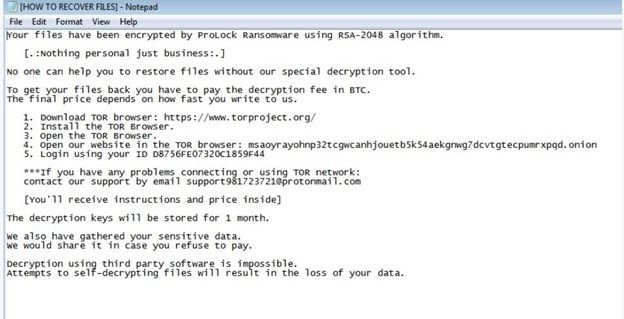
ProLock Ransomware Is A Sophisticated Ransomware Family That Emerged In 2020 And Quickly Became A Significant Threat To Organizations Worldwide. Security Researchers Believe ProLock Evolved From The Earlier PwndLocker Ransomware Family After Operational And Technical Changes Were Introduced By Its Operators. ProLock Is Known For Targeting Enterprise Environments, Encrypting Critical Business Data, And Demanding Substantial Ransom Payments In Exchange For Decryption Tools.
Unlike Commodity Ransomware That Primarily Targets Individual Users, ProLock Was Designed To Compromise Corporate Networks, Municipal Organizations, Healthcare Institutions, Financial Entities, And Other High-value Targets. The Ransomware Operators Often Gained Access Through Phishing Campaigns, Vulnerable Remote Desktop Protocol (RDP) Services, Virtual Private Network (VPN) Vulnerabilities, And Malware Loaders Such As QakBot (Qbot).
One Of The Defining Characteristics Of ProLock Was Its Use Of Double-extortion Tactics. Before Encrypting Files, Attackers Frequently Exfiltrated Sensitive Data And Threatened To Publish Stolen Information If Victims Refused To Pay The Ransom. This Strategy Increased Pressure On Organizations And Amplified The Impact Of Attacks.
This Article Provides A Comprehensive Overview Of ProLock Ransomware, Including Affected Operating Systems, Targeted Files, Infection Statistics, Impacted Countries, Indicators Of Compromise (IOCs), MITRE ATT&CK Techniques, Detection Rules, And Frequently Asked Questions.
| Attribute | Details |
|---|---|
| Malware Name | ProLock Ransomware |
| Malware Type | Ransomware |
| First Observed | 2020 |
| Origin | Successor To PwndLocker |
| Primary Goal | Data Encryption And Extortion |
| Distribution | QakBot, Phishing, RDP Abuse |
| Target Victims | Enterprises And Organizations |
| Extortion Method | Encryption And Data Theft |
| Ransom Payment | Cryptocurrency |
ProLock Became Particularly Dangerous Because It Combined Enterprise Intrusion Techniques With Robust Encryption Capabilities And Data Exfiltration Operations.
A Typical ProLock Attack Follows A Multi-stage Intrusion Process.
Stage 1: Initial Access
Attackers Gain Access Through:
Phishing Emails
Malicious Attachments
Compromised VPN Services
Weak RDP Credentials
QakBot Malware Infections
Exploited Vulnerabilities
Stage 2: Internal Reconnaissance
After Gaining Access, Attackers:
Enumerate Systems
Identify Valuable Assets
Discover Domain Controllers
Locate Backup Infrastructure
Stage 3: Credential Theft
Attackers Harvest:
Domain Credentials
Administrator Passwords
Service Accounts
VPN Credentials
Stage 4: Lateral Movement
The Attackers Move Across The Network Using:
SMB
RDP
PowerShell
Administrative Tools
Stage 5: Data Exfiltration
Sensitive Information Is Collected And Transmitted To Attacker-controlled Servers.
Stage 6: Encryption
ProLock Encrypts Targeted Files And Leaves Ransom Notes Throughout The Environment.
ProLock Primarily Targets Microsoft Windows Environments.
Known Affected Windows Versions
Windows 7
Windows 8
Windows 8.1
Windows 10
Windows 11
Windows Server 2008
Windows Server 2012
Windows Server 2016
Windows Server 2019
Windows Server 2022
Linux Systems
No Widespread Linux-specific ProLock Encryptor Has Been Publicly Documented.
macOS
No Significant MacOS-targeting ProLock Variant Has Been Identified.
Although ProLock Itself Focuses On Encryption, Associated Intrusion Activities Often Target Browser-stored Credentials.
Browsers Commonly Exposed
Google Chrome
Mozilla Firefox
Microsoft Edge
Internet Explorer
Opera
Brave
Browser Data Potentially Accessed
Saved Passwords
Session Cookies
Authentication Tokens
Browser History
Autofill Information
Compromised Browser Credentials May Facilitate Privilege Escalation And Lateral Movement Within Enterprise Environments.
ProLock Operators And Associated Malware Loaders May Access Information Stored Within Browser Extensions.
Commonly Exposed Extension Categories
Password Managers
Cryptocurrency Wallet Extensions
Cloud Storage Plugins
Corporate Authentication Extensions
VPN Browser Extensions
Potentially Compromised Data
Login Credentials
Session Tokens
API Keys
Wallet Metadata
Authentication Secrets
ProLock Focuses On Encrypting Valuable Organizational Data While Avoiding Files That Could Destabilize The Operating System.
.doc
.docx
.xls
.xlsx
.ppt
.pptx
.pdf
.txt
.rtf
.sql
.db
.sqlite
.mdb
.accdb
.zip
.rar
.7z
.tar
.gz
.jpg
.jpeg
.png
.bmp
.gif
.tiff
.mp3
.wav
.mp4
.mov
.avi
.mkv
.java
.py
.php
.js
.cpp
.cs
.html
Financial Records
Customer Databases
HR Documents
Legal Documents
Intellectual Property
Backup Repositories
Encrypted Files Typically Receive Ransomware-specific Extensions Depending On The Campaign.
ProLock Employs Strong Encryption Algorithms To Render Files Inaccessible.
Characteristics
Fast Encryption Process
Enterprise-scale Deployment
Network Share Encryption
File Extension Modification
Ransom Note Creation
The Malware Is Capable Of Encrypting Thousands Of Files Across Multiple Systems In A Short Period.
Exact Infection Numbers Remain Unknown Because Ransomware Operators Do Not Disclose Victim Counts And Many Incidents Remain Private.
However, Public Investigations And Incident Response Reports Indicate:
Hundreds Of Organizations Were Targeted.
Numerous Enterprise Networks Were Compromised.
Victims Included Healthcare, Government, Education, Finance, And Manufacturing Sectors.
Attacks Occurred Across Multiple Continents.
Security Researchers Generally Consider ProLock A Significant Enterprise Ransomware Operation Rather Than A Mass-infection Malware Campaign.
Estimated Affected Systems Likely Ranged From Thousands To Tens Of Thousands Of Endpoints Across Compromised Organizations.
ProLock Campaigns Affected Organizations Globally.
Frequently Reported Countries
United States
Canada
United Kingdom
Germany
France
Spain
Italy
Netherlands
Australia
India
Brazil
Mexico
South Africa
Singapore
The United States Accounted For A Substantial Percentage Of Publicly Reported Victims Due To The Group's Focus On High-value Enterprises.
Before Encryption, Attackers Often Collected:
Sensitive Corporate Data
Financial Reports
Customer Information
Employee Records
Intellectual Property
Internal Communications
Credential Information
Domain Credentials
VPN Credentials
Browser Passwords
Administrative Accounts
This Data Theft Enabled Double-extortion Attacks Where Victims Faced Both Operational Disruption And Potential Public Exposure.
The Following IOCs Are Representative Examples Associated With ProLock Investigations. Organizations Should Validate Indicators Against Current Threat Intelligence Feeds Before Deployment.
ProLock_README.txt
README.txt
RECOVER_FILES.txt
.proLock
.locked
.enc
prolock.exe
Update.exe
Encryptor.exe
Mass File Encryption
Shadow Copy Deletion
Backup Destruction
Ransom Note Deployment
Credential Dumping
Network Share Enumeration
Lateral Movement Activity
vssadmin Delete Shadows /all /quiet
Wbadmin Delete Catalog
Bcdedit /set Recoveryenabled No
Organizations Should Investigate:
Connections To Unknown External IP Addresses
Data Exfiltration Traffic
Suspicious PowerShell Communications
Large Outbound Transfers Before Encryption
The Following MITRE ATT&CK Techniques Are Commonly Associated With ProLock Operations.
| ATT&CK ID | Technique |
|---|---|
| T1566 | Phishing |
| T1078 | Valid Accounts |
| T1133 | External Remote Services |
| T1021.001 | Remote Desktop Protocol |
| T1021.002 | SMB/Windows Admin Shares |
| T1087 | Account Discovery |
| T1018 | Remote System Discovery |
| T1082 | System Information Discovery |
| T1003 | OS Credential Dumping |
| T1555 | Credentials From Password Stores |
| T1059.001 | PowerShell |
| T1105 | Ingress Tool Transfer |
| T1041 | Exfiltration Over C2 Channel |
| T1486 | Data Encrypted For Impact |
| T1490 | Inhibit System Recovery |
| T1562 | Impair Defenses |
| T1036 | Masquerading |
| T1070 | Indicator Removal On Host |
ProLock Activity Spans Numerous ATT&CK Tactics:
Initial Access
Execution
Persistence
Privilege Escalation
Defense Evasion
Credential Access
Discovery
Lateral Movement
Collection
Command And Control
Exfiltration
Impact
title: Shadow Copy Deletion Activity
Id: Prolock-shadow-copy-deletion
Status: Experimental

Logsource:
  Product: Windows
  Category: Process_creation

Detection:
  Selection:
    CommandLine|contains:
      - "vssadmin Delete Shadows"
      - "wbadmin Delete Catalog"

  Condition: Selection

Level: High
title: Potential ProLock File Encryption
Id: Prolock-file-encryption
Status: Experimental

Logsource:
  Product: Windows
  Category: File_event

Detection:
  Selection:
    TargetFilename|contains:
      - ".proLock"
      - ".locked"

  Condition: Selection

Level: Critical
title: Suspicious PowerShell Execution
Id: Prolock-powershell
Status: Experimental

Logsource:
  Product: Windows
  Category: Process_creation

Detection:
  Selection:
    Image|endswith:
      - Powershell.exe

  Condition: Selection

Level: Medium
rule ProLock_Ransomware
{
    Meta:
        Description = "Detect Possible ProLock Artifacts"

    Strings:
        $a = "ProLock"
        $b = "RECOVER_FILES"
        $c = "vssadmin Delete Shadows"

    Condition:
        Any Of Them
}
Security Teams Should Monitor For:
Rapid File Encryption Activity
Large-scale File Renaming
Creation Of Ransom Notes
Shadow Copy Deletion
Credential Dumping Activity
Unexpected PowerShell Execution
Lateral Movement Attempts
Network Share Access Spikes
Data Exfiltration Behavior
Behavioral Analytics Often Provide Earlier Detection Than Signature-based Approaches.
Avoid Opening Suspicious Email Attachments.
Verify External Communications.
Report Phishing Attempts.
Deploy Endpoint Detection And Response (EDR).
Restrict RDP Access.
Implement Network Segmentation.
Enforce Least Privilege.
Maintain Offline Backups.
Protect Backup Servers.
Test Restoration Procedures Regularly.
Enable Multi-factor Authentication.
Rotate Privileged Credentials.
Monitor Account Misuse.
Patch VPN Systems.
Patch Exposed Services.
Continuously Scan For Vulnerabilities.
ProLock Is An Enterprise-focused Ransomware Family That Encrypts Files And Often Steals Sensitive Data Before Demanding Payment.
It Commonly Spreads Through Phishing Campaigns, QakBot Infections, Vulnerable VPN Appliances, Exposed RDP Services, And Compromised Credentials.
ProLock Primarily Targets Windows Workstations And Windows Server Environments.
Yes. Many ProLock Attacks Included Data Exfiltration Prior To Encryption As Part Of A Double-extortion Strategy.
It Targets Documents, Databases, Images, Archives, Source Code, Multimedia Files, And Other Business-critical Data.
Although Exact Figures Remain Unavailable, Thousands To Tens Of Thousands Of Systems Were Likely Affected Across Hundreds Of Compromised Organizations Worldwide.
Victims Were Reported Across North America, Europe, Asia-Pacific, South America, And Africa, Including The United States, Canada, United Kingdom, Germany, Australia, India, And Brazil.
Yes. ProLock Can Identify And Encrypt Accessible Network Shares And Mapped Drives.
Detection Can Be Achieved Through EDR Solutions, Behavioral Monitoring, IOC Matching, ATT&CK-based Threat Hunting, And Ransomware Activity Analytics.
Recovery Depends On Available Backups, Incident Response Actions, And The Specific Attack Circumstances. Organizations Should Prioritize Restoration From Secure Backups And Consult Incident Response Professionals Before Considering Ransom Payments.
ProLock Ransomware Emerged As A Highly Effective Enterprise Threat By Combining Network Intrusion Techniques, Credential Theft, Data Exfiltration, And Large-scale File Encryption. Its Evolution From The PwndLocker Family And Its Association With Malware Delivery Mechanisms Such As QakBot Enabled Attackers To Compromise High-value Organizations Across Multiple Sectors.
The Ransomware's Use Of Double Extortion Significantly Increased Pressure On Victims, While Its Ability To Move Laterally And Encrypt Network Resources Amplified Operational Disruption. Organizations Can Reduce Their Risk By Implementing Layered Security Controls, Enforcing Strong Authentication, Maintaining Offline Backups, Monitoring For ATT&CK-aligned Behaviors, And Continuously Hunting For Indicators Of Compromise.
A Proactive Cybersecurity Strategy That Combines Prevention, Detection, Response, And Recovery Remains The Most Effective Defense Against ProLock And Similar Ransomware Operations.
Step 1: Boot Into Safe Mode
Restart Your PC And Press F8 (or Shift + F8 For Some Systems) Before Windows Loads.
Choose Safe Mode With Networking.
Safe Mode Prevents Most Malware From Loading.
Press Win + R, Type appwiz.cpl, And Press Enter.
Sort By Install Date And Uninstall Unknown Or Recently Added Programs.
Use A Trusted Anti-malware Tool:
Malwarebytes – https://www.malwarebytes.com
Screenshot Of Malwarebytes - Visit Links
Microsoft Defender – Built Into Windows 10/11
HitmanPro, ESET Online Scanner, Or Kaspersky Virus Removal Tool
ZoneAlarm Pro Antivirus + Firewall NextGen
VIPRE Antivirus - US And Others Countries, | India
Run A Full Scan And Delete/quarantine Detected Threats.
Win + R, Type temp → Delete All Files.Press Win + R, Type %temp% → Delete All Files.
Use Disk Cleanup: cleanmgr In The Run Dialog.
Go To: C:\Windows\System32\drivers\etc
Open hosts File With Notepad.
Replace With Default Content:
Press Ctrl + Shift + Esc → Open Task Manager
Go To Startup Tab
Disable Any Suspicious Entries.
Open Command Prompt As Administrator.
Run These Commands:
netsh Winsock Reset

netsh Int Ip Reset

ipconfig /flushdns
Unwanted Homepage Or Search Engine
Pop-ups Or Redirects
Unknown Extensions Installed
For Chrome:
Go To: chrome://extensions/
Remove Anything Unfamiliar
For Firefox:
Go To: about:addons → Extensions
Remove Suspicious Add-ons
For Edge:
Go To: edge://extensions/
Uninstall Unknown Add-ons
Chrome:
Go To chrome://settings/reset → "Restore Settings To Their Original Defaults"
Firefox:
Go To about:support → "Refresh Firefox"
Edge:
Go To edge://settings/resetProfileSettings → "Reset Settings"
All Browsers:
Use Ctrl + Shift + Del → Select All Time
Clear Cookies, Cached Files, And Site Data
Make Sure They Are Not Hijacked.
Chrome: chrome://settings/search
Firefox: about:preferences#search
Edge: edge://settings/search
Chrome: chrome://settings/cleanup
Use Malwarebytes Browser Guard For Real-time Browser Protection.
Always Download Software From Trusted Sources.
Keep Windows, Browsers, And Antivirus Updated.
Avoid Clicking Suspicious Links Or Ads.
Use ad Blockers And reputable Antivirus Software.
Backup Your Files Regularly.
To Remove Malware From Your Windows PC, Start By Booting Into Safe Mode, Uninstalling Suspicious Programs, And Scanning With Trusted Anti-malware Tools Like Malwarebytes. Clear Temporary Files, Reset Your Network Settings, And Check Startup Apps For Anything Unusual.
For web Browsers, Remove Unwanted Extensions, Reset Browser Settings, Clear Cache And Cookies, And Ensure Your Homepage And Search Engine Haven’t Been Hijacked. Use Cleanup Tools Like Chrome Cleanup Or Browser Guard For Added Protection.
?? Prevention Tips: Keep Software Updated, Avoid Suspicious Downloads, And Use Antivirus Protection Plus Browser Ad Blockers. Regular Backups Are Essential.
Why It Matters: Not All VPNs Offer Malware Protection.
What To Look For: Providers With built-in Malware/ad/tracker Blockers (e.g., NordVPN’s Threat Protection, ProtonVPN’s NetShield).
Purpose: Prevents Data Leaks If Your VPN Connection Drops.
Benefit: Ensures Your Real IP And Browsing Activity Aren’t Exposed To Malware-distributing Websites.
Why It Matters: DNS Leaks Can Expose Your Online Activity To Attackers.
Solution: Enable DNS Leak Protection In Your VPN Settings Or Use A Secure DNS Like Cloudflare (1.1.1.1).
Risk: Free VPNs Often Contain Malware, Sell User Data, Or Lack Security Features.
Better Option: Use Reputable Paid VPNs That Offer security Audits And Transparent Privacy Policies.
Some VPNs Block Known Phishing And Malicious Sites.
Example: Surfshark’s CleanWeb, CyberGhost’s Content Blocker.
Reason: Security Patches Fix Known Vulnerabilities.
Tip: Enable Auto-updates Or Check For Updates Weekly.
Scope: Malware Can Enter Through Phones, Tablets, Or IoT Devices.
Solution: Install VPN Apps On Every Internet-connected Device.
Fact: VPNs Do Not Remove Or Detect Malware On Your System.
Complement It With:
Antivirus Software
Firewall
Browser Extensions For Script Blocking
VPN Encrypts Traffic But Can’t Stop Malware From Executing If You Download Infected Files.
Split Tunneling Allows Certain Apps/sites To Bypass VPN.
Tip: Never Exclude Browsers, Email Clients, Or Download Managers From VPN Tunneling.
A VPN (Virtual Private Network) Enhances Your Online Privacy By Encrypting Your Internet Traffic And Masking Your IP Address. It Protects Your Data On Public Wi-Fi, Hides Browsing Activity From Hackers And ISPs, And Helps Bypass Geo-restrictions. VPNs Also Add A Layer Of Defense Against Malware By Blocking Malicious Websites And Trackers When Using Advanced Features. However, A VPN Does Not Remove Existing Malware Or Act As Antivirus Software. For Full Protection, Combine VPN Use With Antivirus Tools, Regular Software Updates, And Cautious Browsing Habits. Always Choose A Reputable VPN Provider With Strong Security And Privacy Policies.
ProLock Ransomware, ProLock Ransomware Removal, Remove ProLock Ransomware, Delete ProLock Ransomware, Uninstall ProLock Ransomware, Get Rid Of ProLock