Blog's Page
 Blog's Page
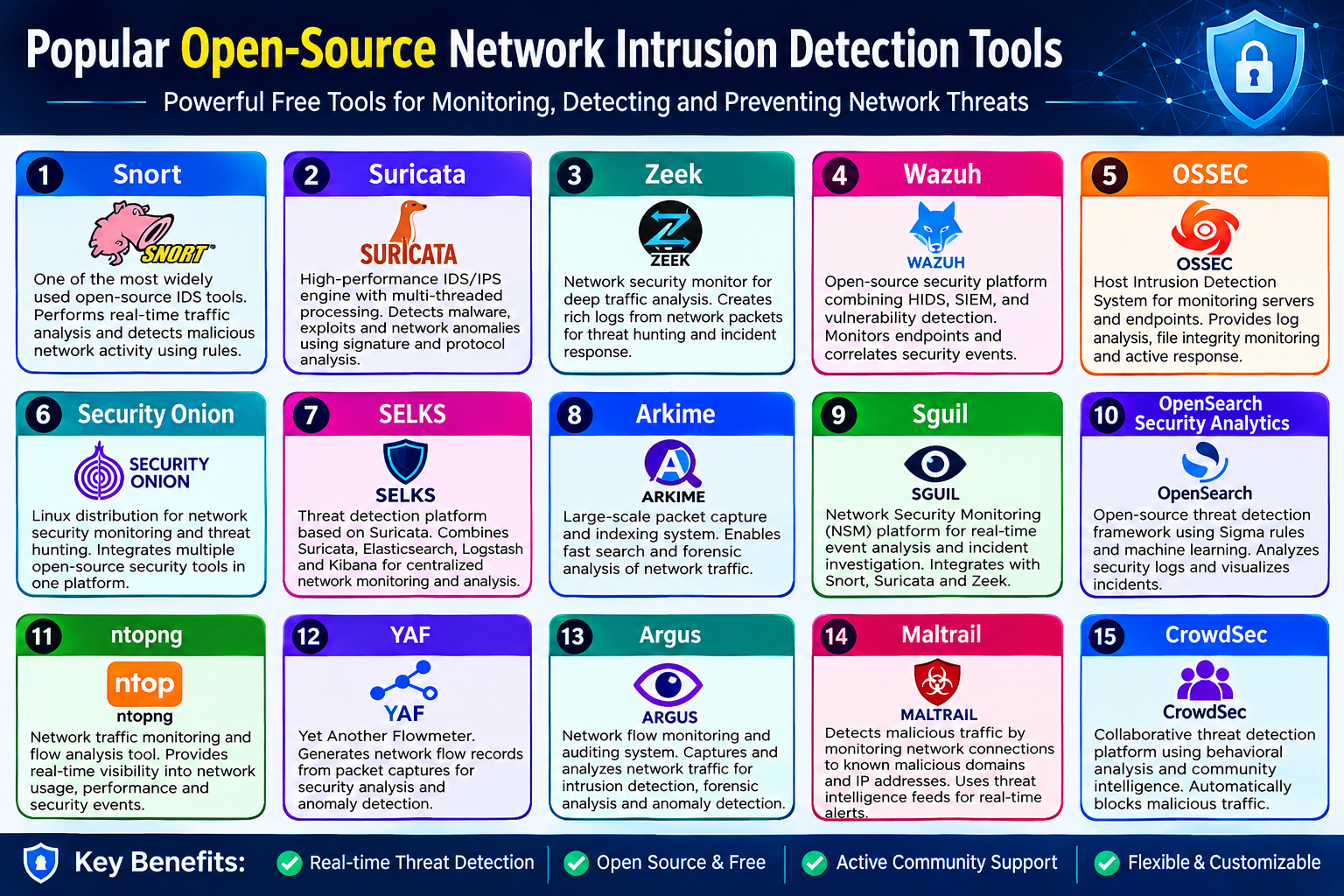
Snort Is One Of The World's Most Widely Used Open-source Network Intrusion Detection Systems (NIDS). It Performs Real-time Traffic Analysis And Packet Logging To Identify Malicious Network Activities. Snort Uses A Large Collection Of Signature-based Detection Rules To Recognize Attacks Such As Malware Communication, Denial-of-service (DoS), Port Scanning, Web Attacks, And Protocol Violations. It Supports Protocol Analysis, Packet Capture, And Customizable Rule Writing. Security Analysts Can Create Their Own Detection Rules For Emerging Threats. Snort Is Widely Deployed In Enterprises, Educational Institutions, Government Organizations, And Cybersecurity Laboratories For Monitoring Network Traffic And Detecting Known Cyber Threats.
Suricata Is A High-performance Open-source Intrusion Detection System (IDS), Intrusion Prevention System (IPS), And Network Security Monitoring (NSM) Platform. Unlike Many Traditional IDS Tools, Suricata Supports Multi-threaded Processing, Making It Suitable For High-speed Enterprise Networks. It Can Inspect HTTP, HTTPS, FTP, DNS, SMTP, TLS, SSH, And Many Other Protocols. Suricata Detects Malware, Exploits, Ransomware, Command-and-control (C2) Communication, And Network Anomalies Using Both Signature-based And Protocol-aware Detection Techniques. It Also Produces Detailed JSON Logs For Integration With SIEM Platforms, Making It A Popular Choice For Modern Security Operations Centers (SOCs).
Zeek, Formerly Known As Bro, Is An Open-source Network Security Monitoring Platform Designed For Deep Traffic Analysis Rather Than Traditional Signature Matching. It Converts Raw Network Packets Into Rich Security Logs, Enabling Investigators To Analyze User Behavior, Protocol Activities, DNS Requests, SSL Certificates, File Transfers, And Application Events. Zeek Supports Scripting, Allowing Security Teams To Create Custom Detection Policies For Advanced Threats. It Is Particularly Effective For Threat Hunting, Incident Response, Forensic Investigations, And Detecting Insider Attacks. Large Enterprises, Universities, And Research Institutions Commonly Use Zeek For Comprehensive Visibility Into Network Operations.
Wazuh Is An Open-source Security Platform That Combines Host Intrusion Detection (HIDS), Security Information And Event Management (SIEM), Vulnerability Detection, Log Analysis, And File Integrity Monitoring. It Collects Security Events From Windows, Linux, MacOS, Cloud Environments, Containers, And Virtual Machines. Wazuh Can Detect Unauthorized File Changes, Malware, Rootkits, Suspicious Logins, Privilege Escalation, And Compliance Violations. It Integrates With Elasticsearch And OpenSearch Dashboards For Visualization. Organizations Frequently Use Wazuh To Monitor Endpoints While Correlating Security Events Across Their Infrastructure, Making It A Comprehensive Cybersecurity Monitoring Solution.
OSSEC Is An Open-source Host Intrusion Detection System Designed To Monitor Servers And Endpoints For Suspicious Activities. It Performs Log Analysis, Rootkit Detection, File Integrity Monitoring, Registry Monitoring, Active Response, And Policy Enforcement. OSSEC Continuously Monitors Operating Systems For Unauthorized Modifications And Suspicious Events That May Indicate Malware Infections Or Insider Threats. It Supports Windows, Linux, Unix, And MacOS Platforms. Security Administrators Often Deploy OSSEC To Strengthen Endpoint Security While Integrating It With Centralized Monitoring Solutions For Enterprise-wide Intrusion Detection And Compliance Management.
Security Onion Is A Linux Distribution Built Specifically For Network Security Monitoring, Intrusion Detection, And Threat Hunting. It Integrates Numerous Open-source Security Tools Including Snort, Suricata, Zeek, Wazuh, Elasticsearch, Kibana, Fleet, And CyberChef Into A Single Platform. Security Onion Simplifies Deployment By Providing Dashboards, Alert Management, Packet Capture, And Forensic Capabilities. Security Analysts Use It To Investigate Malware Infections, Lateral Movement, Ransomware Attacks, And Insider Threats. It Is Widely Used In Cybersecurity Education, Research Laboratories, Government Organizations, And Enterprise SOC Environments For Comprehensive Security Monitoring.
SELKS Is An Open-source Threat Detection Platform Developed Around Suricata IDS. It Combines Suricata, Elasticsearch, Logstash, Kibana, And Scirius Community Edition Into A Unified Environment For Network Monitoring And Threat Analysis. SELKS Provides Preconfigured Dashboards, Rule Management, Alert Visualization, And Security Reporting, Making Deployment Easier Than Configuring Each Component Separately. It Supports Intrusion Detection, Malware Monitoring, Protocol Analysis, And Network Traffic Visualization. Organizations Seeking A Complete IDS Solution With Centralized Management Frequently Deploy SELKS In Enterprise Networks And Cybersecurity Training Environments.
Arkime, Formerly Known As Moloch, Is An Open-source Large-scale Packet Capture And Indexing System. It Captures Complete Network Packets While Indexing Metadata For Rapid Searching And Forensic Investigations. Security Analysts Can Quickly Reconstruct Sessions, Inspect Files, Analyze Communications, And Investigate Suspicious Network Behavior. Arkime Supports Distributed Deployments Capable Of Processing Terabytes Of Network Traffic Daily. It Integrates With Elasticsearch And Other Security Platforms For Advanced Threat Hunting. Enterprises, Incident Response Teams, And Government Agencies Use Arkime To Retain And Analyze Historical Network Traffic During Cybersecurity Investigations.
Sguil Is An Open-source Network Security Monitoring (NSM) Platform Designed For Real-time Event Analysis And Incident Investigation. It Combines Alerts From Intrusion Detection Systems With Packet Captures, Session Data, And Analyst Workflows Into A Centralized Interface. Sguil Enables Analysts To Investigate Suspicious Events By Reviewing Correlated Evidence Rather Than Isolated Alerts. It Integrates With Snort, Suricata, Zeek, And Other Monitoring Tools To Improve Detection Accuracy. Security Operations Centers Often Deploy Sguil To Streamline Incident Response, Reduce False Positives, And Improve Analyst Productivity.
OpenSearch Security Analytics Is An Open-source Threat Detection Framework That Analyzes Security Logs Using Sigma Detection Rules And Machine Learning Techniques. It Ingests Data From Various Security Sources, Including Firewalls, IDS Platforms, Cloud Services, And Endpoint Protection Tools. Analysts Can Create Custom Detection Rules, Visualize Alerts, And Investigate Security Incidents Through Interactive Dashboards. It Supports Automated Workflows, Threat Correlation, And Centralized Monitoring Across Hybrid Environments. Organizations Use OpenSearch Security Analytics To Strengthen SIEM Capabilities While Reducing Response Times To Emerging Cyber Threats.
ntopng Is An Open-source Network Traffic Monitoring And Flow Analysis Tool That Provides Detailed Visibility Into Bandwidth Usage, Application Traffic, Network Performance, And Security Events. It Supports NetFlow, IPFIX, SFlow, And Packet Analysis For Monitoring Network Communications. Administrators Use Ntopng To Identify Suspicious Hosts, Unusual Traffic Patterns, Distributed Denial-of-service Attacks, And Bandwidth Abuse. Interactive Dashboards Display Real-time Network Statistics And Historical Trends. Although Primarily A Network Monitoring Solution, Ntopng Also Assists Cybersecurity Teams By Identifying Anomalies That May Indicate Malicious Activity.
YAF Is An Open-source Network Flow Generation Tool That Converts Raw Packet Captures Into Flow Records For Security Analysis. It Supports IPv4, IPv6, TCP, UDP, And Various Application Protocols. Flow Records Generated By YAF Can Be Analyzed Using Intrusion Detection, Anomaly Detection, And Traffic Analysis Tools. Because Flow Data Requires Less Storage Than Full Packet Captures, YAF Enables Long-term Monitoring Of Large Enterprise Networks. Security Researchers And SOC Analysts Use YAF To Identify Suspicious Communication Patterns, Malware Activity, And Unauthorized Network Connections.
Argus (Audit Record Generation And Utilization System) Is An Open-source Network Flow Monitoring And Auditing Platform. It Continuously Captures Network Traffic And Generates Detailed Flow Records Describing Communications Between Hosts. Security Professionals Use Argus For Intrusion Detection, Forensic Analysis, Anomaly Detection, And Network Performance Monitoring. Its Extensive Command-line Tools Support Advanced Filtering, Statistical Analysis, And Historical Reporting. Because It Efficiently Stores Long-term Flow Information, Argus Is Widely Used By Research Organizations, Internet Service Providers, Universities, And Enterprise Security Teams To Investigate Cyber Incidents.
Maltrail Is An Open-source Malicious Traffic Detection System Designed To Identify Communication With Known Malicious Domains, IP Addresses, URLs, And Command-and-control Servers. It Utilizes Continuously Updated Threat Intelligence Feeds From Numerous Public Sources And Security Researchers. Maltrail Monitors DNS Requests, HTTP Traffic, And Network Connections To Detect Malware Infections, Ransomware Communications, Botnets, Phishing Attacks, And Exploit Kits. It Generates Real-time Alerts And Provides A Lightweight Web Interface For Monitoring. Its Simple Deployment And Low Resource Requirements Make It Suitable For Organizations Of All Sizes.
CrowdSec Is An Open-source Collaborative Threat Detection And Automated Response Platform That Analyzes Logs From Servers, Applications, Firewalls, And Network Devices. Using Behavioral Analysis And Community-driven Threat Intelligence, CrowdSec Detects Brute-force Attacks, Credential Stuffing, Web Exploitation Attempts, Scanning Activities, And Malicious Bots. It Can Automatically Block Attackers Through Integrated Firewalls, Reverse Proxies, And Security Appliances. Unlike Traditional IDS Solutions That Rely Primarily On Signatures, CrowdSec Emphasizes Behavioral Detection And Shared Intelligence, Enabling Organizations To Improve Protection Against Evolving Cyber Threats While Benefiting From Community-contributed Detection Scenarios.
Here Are The Official Websites (or Official Project Pages) For Each Of The 15 Popular Open-source Network Intrusion Detection Tools.
| No. | Tool | Official Website |
|---|---|---|
| 1 | Snort | Open-source Network Intrusion Detection System (NIDS) |
| 2 | Suricata | High-performance IDS, IPS, And Network Security Monitoring |
| 3 | Zeek | Open-source Network Security Monitoring Platform |
| 4 | Wazuh | Open-source Security Platform (HIDS, SIEM, XDR) |
| 5 | OSSEC | Open-source Host Intrusion Detection System |
| 6 | Security Onion | Linux Distribution For Threat Hunting And Network Monitoring |
| 7 | SELKS | Suricata-based Threat Detection Platform |
| 8 | Arkime | Large-scale Packet Capture And Network Forensics |
| 9 | Sguil | Network Security Monitoring (NSM) Platform |
| 10 | OpenSearch Security Analytics | Open-source Threat Detection And SIEM Analytics |
| 11 | ntopng | Network Traffic Monitoring And Flow Analysis |
| 12 | YAF (Yet Another Flowmeter) | Network Flow Generation And Analysis |
| 13 | Argus | Network Flow Monitoring And Auditing System |
| 14 | Maltrail | Malicious Traffic Detection Using Threat Intelligence |
| 15 | CrowdSec | Collaborative Threat Detection And Automated Response |
These Links Point To The Official Project Websites Or Official Documentation Pages Maintained By The Developers, Making Them Suitable References For Research Papers, Technical Documentation, And Cybersecurity Tutorials.
Open-Source Network Intrusion Detection Tools, Network Intrusion Detection Tools