Blog's Page
 Blog's Page
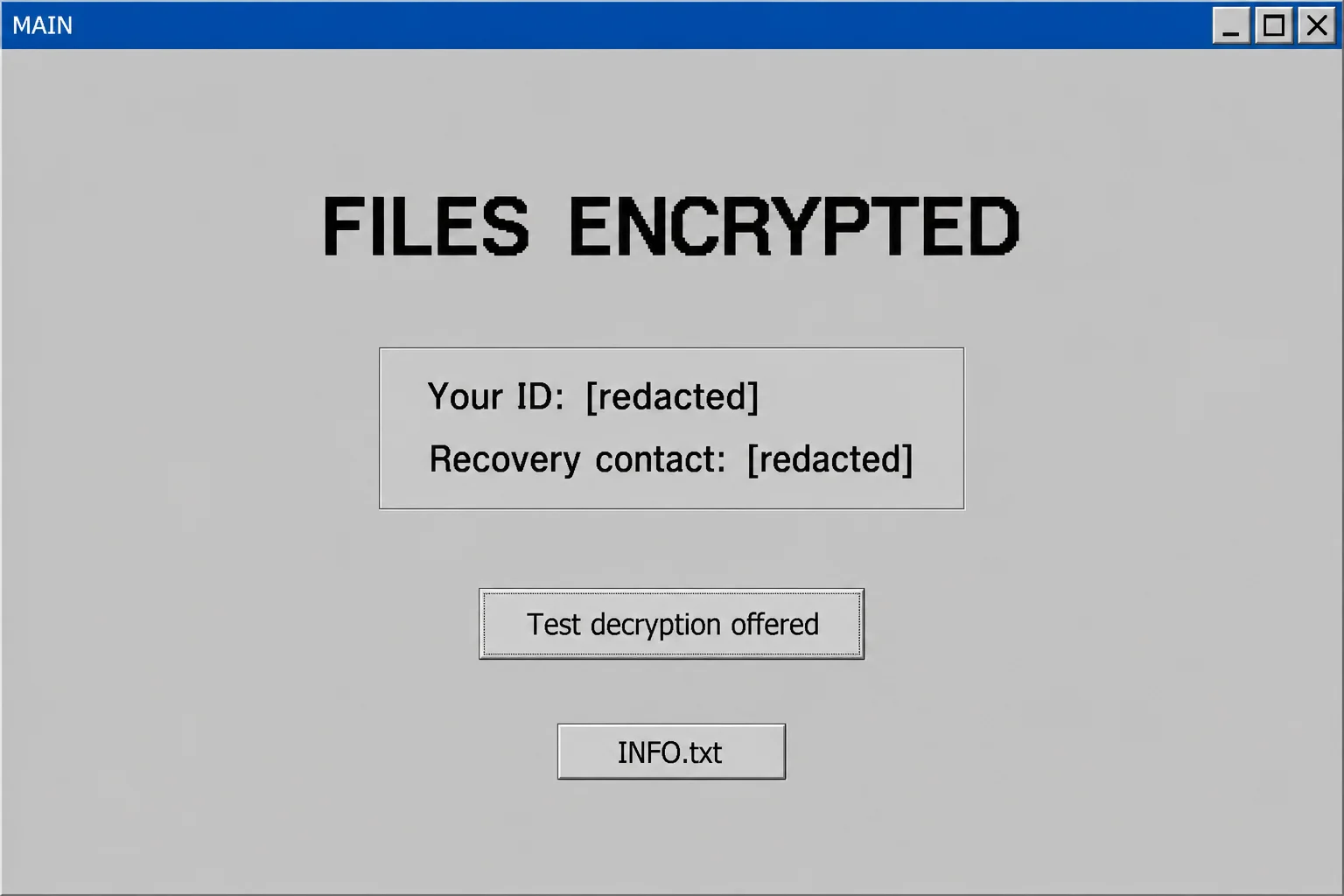
Learn What MAIN Ransomware Is, Its Symptoms, Encrypted Files, Detection Methods, Affected Systems, Removal Steps, Recovery Options, And Prevention Techniques.
Keywords: MAIN Ransomware Removal, MAIN Ransomware Symptoms, MAIN Ransomware Encrypted Files, MAIN Ransomware Detection, MAIN Ransomware Prevention, MAIN Malware, Ransomware Attack, Ransomware Recovery, Encrypted Files, Windows Ransomware
MAIN Ransomware Is A Ransomware-type Malware Threat That Can Compromise A Computer And Prevent Victims From Accessing Their Files. Ransomware Attacks Are Designed Primarily To Create A Financial Or Operational Impact By Denying Access To Valuable Data And Demanding Payment For Recovery.
A Ransomware Infection Can Affect Personal Computers, Business Workstations, Servers, And Shared Network Resources. Depending On The Particular Malware Variant And Attack Campaign, Victims May Experience File Encryption, Modified Filenames, Ransom Notes, System Disruption, Data Theft, Or Attempts To Disable Security And Recovery Mechanisms.
Because Ransomware Names Can Sometimes Be Reused Or Associated With Different Malware Samples, Security Researchers Should Verify The Exact file Extension, Ransom Note, Malware Hash, Behavior, And Distribution Method Before Attributing An Incident Specifically To MAIN Ransomware.
MAIN Ransomware Refers To A Ransomware Threat That Attempts To Make Files Inaccessible And Potentially Extort Victims For Money. The Malware May Search For Valuable Files And Modify Them So That Normal Applications Can No Longer Open Them.
Important Files Potentially Targeted By Ransomware Include:
Documents
PDF Files
Images
Videos
Databases
Archives
Financial Records
Business Documents
Source-code Files
Project Files
Backup-related Data
The Ultimate Impact Depends On The Privileges Available To The Malware And The Systems Accessible From The Compromised Account.
A Ransomware Attack Generally Involves Several Stages.
First, Attackers Need An Initial Access Mechanism. This Can Involve Phishing, Malicious Downloads, Compromised Credentials, Vulnerabilities, Or Exposed Remote-access Services.
After Gaining Access, Malware May Execute On The System And Attempt To Discover Local And Network Resources. The Attacker May Then Attempt To Obtain Higher Privileges Or Access Additional Systems.
The Ransomware Can Subsequently Search For Files And Begin Modifying Or Encrypting Them.
Finally, Victims May Receive A Ransom Note Containing Instructions For Contacting The Attackers And Making A Payment.
The Exact Behavior Of MAIN Ransomware Should Be Confirmed Through Technical Analysis Of The Specific Sample Rather Than Assuming That Every Sample Follows An Identical Attack Sequence.
Ransomware Can Reach Computers Through Numerous Channels.
Attackers Can Distribute Malicious Documents, Executable Attachments, Or Links Through Carefully Crafted Phishing Messages.
Fake Applications, Software Updates, Cracks, Key Generators, And Pirated Programs Can Potentially Contain Ransomware.
Unpatched Operating Systems, Applications, VPN Services, Web Applications, And Remote-access Products Can Provide Opportunities For Attackers.
Compromised Usernames And Passwords Can Allow Attackers To Access Systems Without Exploiting A Software Vulnerability.
Poorly Secured Remote-access Services Can Become Targets For Unauthorized Access.
Malicious Advertisements, Compromised Websites, Or Drive-by Downloads Can Expose Users To Malware.
A Ransomware Infection Can Produce Several Noticeable Symptoms.
Previously Accessible Files May Suddenly Produce Errors Or Appear Corrupted.
The Malware May Modify Filenames Or Add A Distinctive Extension.
A Text, HTML, Or Other Document May Appear Explaining That Files Have Been Encrypted.
Hundreds Or Thousands Of Files Can Potentially Be Changed Within A Short Period.
Encryption Processes Can Generate Significant Disk Activity And System-resource Usage.
Files Stored On Accessible Shared Folders May Also Become Unavailable.
Some Ransomware Attacks Attempt To Interfere With Antivirus Or Endpoint Security Software.
Attackers May Attempt To Delete Or Encrypt Backups That Are Accessible From Compromised Systems.
File Encryption Is One Of The Most Important Characteristics Of Ransomware.
An Encrypted File Might Appear As:
document.docx → Document.docx.[new-extension]or:
photo.jpg → Photo.jpg.[new-extension]The Exact Extension Should Be Confirmed From A Verified Sample Before Publishing It As A MAIN Ransomware Indicator.
Do Not Assume That Removing A Ransomware Extension Will Restore The File.
For Example:
report.pdf.[extension]cannot Normally Be Recovered Simply By Renaming It To:
report.pdfThe Contents Of The File May Have Been Cryptographically Transformed.
Ransomware Usually Creates A Ransom Note After Completing Or Partially Completing Its Encryption Process.
A Ransom Note Can Contain:
Payment Instructions
Cryptocurrency Requirements
Contact Information
Victim Identification Information
Deadlines
Threats
Instructions For Contacting The Attacker
The Ransom Note Is Useful For Incident Investigation And Should Be Preserved As Evidence.
A Ransom Note's Claims Should Not Automatically Be Accepted As Factual. For Example, If The Note Claims That Confidential Information Was Stolen, Investigators Should Examine Network And Endpoint Evidence To Determine Whether Exfiltration Actually Occurred.
Effective Ransomware Detection Requires Both signature-based And Behavioral Monitoring.
Security Teams Should Monitor For:
Large-scale File Modifications
Unusual File Extensions
Suspicious Executable Processes
Unexpected PowerShell Activity
Abnormal Command-line Execution
Unauthorized Administrative Activity
Suspicious Scheduled Tasks
Newly Created Services
Attempts To Disable Security Software
Backup Deletion
Shadow-copy Manipulation
Unusual Remote-login Activity
Suspicious Outbound Network Connections
Large Unexpected Data Transfers
EDR Systems Can Detect Suspicious Relationships Between Processes And File-system Activity.
For Example, A Previously Unknown Process That Rapidly Modifies Thousands Of Documents Should Generate A High-priority Security Alert.
A SIEM Can Correlate:
Endpoint Events
Authentication Logs
Firewall Logs
DNS Activity
Server Events
Cloud Logs
Network Traffic
This Can Help Security Teams Identify Ransomware Activity Across Multiple Systems.
The Operating-system Impact Of A Particular MAIN Ransomware Sample Should Be Determined From Malware Analysis.
Windows Environments Are Common Ransomware Targets Because Of Their Widespread Use In Consumer And Enterprise Environments. However, It Is Not Technically Appropriate To Claim That Every Windows Version Or Every Operating System Is Affected Without Evidence From The Specific Malware Sample.
Potentially Relevant Environments May Include:
Windows Desktops
Windows Laptops
Windows Workstations
Windows Servers
Windows File Servers
Windows-based Business Networks
Network Shares Accessible From Compromised Systems
Security Researchers Should Verify Platform Compatibility Using Malware Analysis, Sandbox Execution, Reverse Engineering, And Trusted Threat-intelligence Sources.
There May Be Insufficient Publicly Verified Information To Establish A Definitive Country-by-country Victim List For MAIN Ransomware.
Because Ransomware Can Be Distributed Through The Internet, Organizations In Many Geographic Regions Could Potentially Be Targeted. However, potential Worldwide Reach Should Not Be Confused With Confirmed Infections.
For An Accurate Cybersecurity Blog, Avoid Publishing Unsupported Statements Such As "MAIN Ransomware Has Infected India, The United States, The UK, And Germany" Unless Those Countries Are Supported By Reliable Incident Data.
A Safer Statement Is:
There Is No Reliable Public Country-specific Victim List Established For MAIN Ransomware. Internet-connected Organizations Worldwide Should Maintain Appropriate Ransomware Defenses.
Some Ransomware Operations Use double Extortion, Where Attackers Allegedly Steal Sensitive Information Before Encrypting Files.
If MAIN Ransomware Is Suspected, Organizations Should Investigate Both:
Data Availability: Were Files Encrypted?
Data Confidentiality: Was Information Copied Or Exfiltrated?
Investigators Should Examine:
Firewall Logs
Proxy Logs
DNS Records
Cloud Audit Logs
Endpoint Telemetry
Authentication Logs
File-access Logs
Network-flow Information
This Distinction Is Particularly Important For Organizations Handling Financial, Healthcare, Government, Educational, Or Customer Information.
If A MAIN Ransomware Infection Is Suspected, containment Should Be The First Priority.
Disconnect The Affected System From The Network To Reduce The Possibility Of Additional Encryption Or Lateral Movement.
Ensure That Clean Backup Systems Are Not Accessible From Potentially Compromised Accounts.
Save Ransom Notes, Suspicious Files, Logs, And Representative Encrypted Files If Forensic Analysis Is Required.
Check Servers, Workstations, Network Shares, Cloud Accounts, And Administrator Accounts.
Determine How The Attackers Entered The Environment.
Security Professionals Should Identify And Remove Malicious Services, Scheduled Tasks, Startup Mechanisms, Or Other Persistence Mechanisms.
Reset Credentials That May Have Been Exposed During The Incident.
Fix The Vulnerability Or Configuration Weakness That Allowed The Compromise.
Restore Affected Systems From Verified Clean Backups After Confirming That The Environment Has Been Secured.
File Recovery Depends On The Exact Ransomware Variant And Encryption Implementation.
Potential Recovery Methods Include:
Offline Backups
Immutable Backups
Cloud Version History
System Recovery Mechanisms
Legitimate Security-research Decryptors
Professional Forensic Recovery
If A Legitimate Decryptor Becomes Available, It Should Be Obtained Only From A Reputable Cybersecurity Source.
Victims Should Avoid Downloading Unknown "MAIN Ransomware Decryptor" Programs From Random Websites Because Fake Recovery Tools Can Contain Additional Malware.
Paying The Ransom Does Not Guarantee That Encrypted Files Will Be Recovered.
Attackers May:
Fail To Provide A Functional Decryptor.
Demand Additional Money.
Continue Extortion.
Publish Allegedly Stolen Information.
Attack The Organization Again.
Organizations Should Follow Their Incident-response Policies And Consult Appropriate Cybersecurity And Legal Professionals Before Making Decisions Concerning Ransom Demands.
A Layered Security Strategy Provides The Strongest Protection.
Keep Important Data In Backups That Are Isolated From Ordinary User And Administrator Access.
Where Possible, Use Backup Systems That Prevent Attackers From Modifying Or Deleting Historical Backup Copies.
MFA Should Be Enabled For:
Administrator Accounts
VPN
Cloud Services
Remote-access Services
Privileged Applications
Patch:
Operating Systems
Browsers
Applications
VPN Appliances
Firewalls
Servers
Remote-management Software
Modern Endpoint Protection And EDR Can Detect Suspicious Encryption And Malicious Process Behavior.
Users Should Have Only The Permissions Required For Their Work.
Separate Critical Servers, Databases, Employee Systems, And Backup Infrastructure Where Appropriate.
Restrict And Monitor RDP, VPN, SSH, Remote-management Services, And Other External Access Points.
Security Awareness Training Should Cover Phishing, Suspicious Attachments, Malicious Websites, Fake Software Updates, And Social Engineering.
Mass File Modification Is An Important Behavioral Indicator Of Ransomware And Should Generate Alerts In Enterprise Environments.
If MAIN Ransomware Is Detected:
Isolate Affected Systems.
Protect Clean Backups.
Preserve Ransom Notes And Malware Evidence.
Identify Affected Accounts.
Determine The Initial Infection Vector.
Search For Lateral Movement.
Investigate Potential Data Exfiltration.
Remove Malicious Persistence.
Patch Vulnerabilities.
Reset Compromised Credentials.
Verify System Integrity.
Restore From Clean Backups.
Monitor Restored Systems.
Document The Incident.
Improve Security Controls Based On Lessons Learned.
MAIN Ransomware Represents The Broader Threat Posed By File-encrypting Malware And Ransomware Attacks. A Successful Infection Can Prevent Access To Important Files, Disrupt Business Operations, Compromise Network Resources, And Potentially Create Additional Data-exposure Risks.
Because Ransomware Variants Can Change Their Technical Characteristics, Cybersecurity Researchers Should Verify The exact Sample, File Extension, Ransom Note, Hashes, Operating-system Compatibility, And Distribution Method Before Publishing Highly Specific Indicators.
The Best Defense Is A Combination Of regular Offline Or Immutable Backups, Multi-factor Authentication, Endpoint Detection And Response, Vulnerability Management, Network Segmentation, Least-privilege Access, Secure Remote Services, Email Security, And Employee Awareness Training.
Early Detection Can Significantly Reduce The Impact Of Ransomware. Organizations Should Monitor For Unusual Processes, Mass File Modifications, Suspicious Authentication Activity, Unexpected Network Connections, And Attempts To Interfere With Backups Or Security Controls.
Step 1: Boot Into Safe Mode
Restart Your PC And Press F8 (or Shift + F8 For Some Systems) Before Windows Loads.
Choose Safe Mode With Networking.
Safe Mode Prevents Most Malware From Loading.
Press Win + R, Type appwiz.cpl, And Press Enter.
Sort By Install Date And Uninstall Unknown Or Recently Added Programs.
Use A Trusted Anti-malware Tool:
Malwarebytes – https://www.malwarebytes.com
Screenshot Of Malwarebytes - Visit Links
Microsoft Defender – Built Into Windows 10/11
HitmanPro, ESET Online Scanner, Or Kaspersky Virus Removal Tool
ZoneAlarm Pro Antivirus + Firewall NextGen
VIPRE Antivirus - US And Others Countries, | India
Run A Full Scan And Delete/quarantine Detected Threats.
Win + R, Type temp → Delete All Files.Press Win + R, Type %temp% → Delete All Files.
Use Disk Cleanup: cleanmgr In The Run Dialog.
Go To: C:\Windows\System32\drivers\etc
Open hosts File With Notepad.
Replace With Default Content:
Press Ctrl + Shift + Esc → Open Task Manager
Go To Startup Tab
Disable Any Suspicious Entries.
Open Command Prompt As Administrator.
Run These Commands:
netsh Winsock Reset

netsh Int Ip Reset

ipconfig /flushdns
Unwanted Homepage Or Search Engine
Pop-ups Or Redirects
Unknown Extensions Installed
For Chrome:
Go To: chrome://extensions/
Remove Anything Unfamiliar
For Firefox:
Go To: about:addons → Extensions
Remove Suspicious Add-ons
For Edge:
Go To: edge://extensions/
Uninstall Unknown Add-ons
Chrome:
Go To chrome://settings/reset → "Restore Settings To Their Original Defaults"
Firefox:
Go To about:support → "Refresh Firefox"
Edge:
Go To edge://settings/resetProfileSettings → "Reset Settings"
All Browsers:
Use Ctrl + Shift + Del → Select All Time
Clear Cookies, Cached Files, And Site Data
Make Sure They Are Not Hijacked.
Chrome: chrome://settings/search
Firefox: about:preferences#search
Edge: edge://settings/search
Chrome: chrome://settings/cleanup
Use Malwarebytes Browser Guard For Real-time Browser Protection.
Always Download Software From Trusted Sources.
Keep Windows, Browsers, And Antivirus Updated.
Avoid Clicking Suspicious Links Or Ads.
Use ad Blockers And reputable Antivirus Software.
Backup Your Files Regularly.
To Remove Malware From Your Windows PC, Start By Booting Into Safe Mode, Uninstalling Suspicious Programs, And Scanning With Trusted Anti-malware Tools Like Malwarebytes. Clear Temporary Files, Reset Your Network Settings, And Check Startup Apps For Anything Unusual.
For web Browsers, Remove Unwanted Extensions, Reset Browser Settings, Clear Cache And Cookies, And Ensure Your Homepage And Search Engine Haven’t Been Hijacked. Use Cleanup Tools Like Chrome Cleanup Or Browser Guard For Added Protection.
?? Prevention Tips: Keep Software Updated, Avoid Suspicious Downloads, And Use Antivirus Protection Plus Browser Ad Blockers. Regular Backups Are Essential.
Why It Matters: Not All VPNs Offer Malware Protection.
What To Look For: Providers With built-in Malware/ad/tracker Blockers (e.g., NordVPN’s Threat Protection, ProtonVPN’s NetShield).
Purpose: Prevents Data Leaks If Your VPN Connection Drops.
Benefit: Ensures Your Real IP And Browsing Activity Aren’t Exposed To Malware-distributing Websites.
Why It Matters: DNS Leaks Can Expose Your Online Activity To Attackers.
Solution: Enable DNS Leak Protection In Your VPN Settings Or Use A Secure DNS Like Cloudflare (1.1.1.1).
Risk: Free VPNs Often Contain Malware, Sell User Data, Or Lack Security Features.
Better Option: Use Reputable Paid VPNs That Offer security Audits And Transparent Privacy Policies.
Some VPNs Block Known Phishing And Malicious Sites.
Example: Surfshark’s CleanWeb, CyberGhost’s Content Blocker.
Reason: Security Patches Fix Known Vulnerabilities.
Tip: Enable Auto-updates Or Check For Updates Weekly.
Scope: Malware Can Enter Through Phones, Tablets, Or IoT Devices.
Solution: Install VPN Apps On Every Internet-connected Device.
Fact: VPNs Do Not Remove Or Detect Malware On Your System.
Complement It With:
Antivirus Software
Firewall
Browser Extensions For Script Blocking
VPN Encrypts Traffic But Can’t Stop Malware From Executing If You Download Infected Files.
Split Tunneling Allows Certain Apps/sites To Bypass VPN.
Tip: Never Exclude Browsers, Email Clients, Or Download Managers From VPN Tunneling.
A VPN (Virtual Private Network) Enhances Your Online Privacy By Encrypting Your Internet Traffic And Masking Your IP Address. It Protects Your Data On Public Wi-Fi, Hides Browsing Activity From Hackers And ISPs, And Helps Bypass Geo-restrictions. VPNs Also Add A Layer Of Defense Against Malware By Blocking Malicious Websites And Trackers When Using Advanced Features. However, A VPN Does Not Remove Existing Malware Or Act As Antivirus Software. For Full Protection, Combine VPN Use With Antivirus Tools, Regular Software Updates, And Cautious Browsing Habits. Always Choose A Reputable VPN Provider With Strong Security And Privacy Policies.
MAIN Ransomware, Ransomware, Malware, Cybersecurity, Ransomware Detection, Ransomware Prevention, Malware Removal, File Encryption, Windows Security,